
A couple of years ago Karpathy called the then-current form of LLMs "jagged intelligence": a model that solves olympiad maths and then tells you 9.11 is bigger than 9.9. Fast forward to today, AI has gotten even more jagged. In September OpenAI said a swarm of 10,000 agents had produced a Lean-checked proof that it claims resolves Navier-Stokes, one of the Millennium Prize Problems. Earlier this year, when people asked leading models whether to walk or drive to a car wash 50 metres away, 42 of 53 said walk, forgetting the car has to get there too. And the best model still reads an analog clock right only two times in three. Most people get it nine times in ten.
My argument is that the jaggedness leaks out of the model. It shows up in the outcomes of the companies built on it, in the founders who win, and it has to show up in the people who fund them. The frontier is jagged, the founders are jagged, and the financiers now have to be jagged too.
1. The frontier: taller peaks, deeper valleys
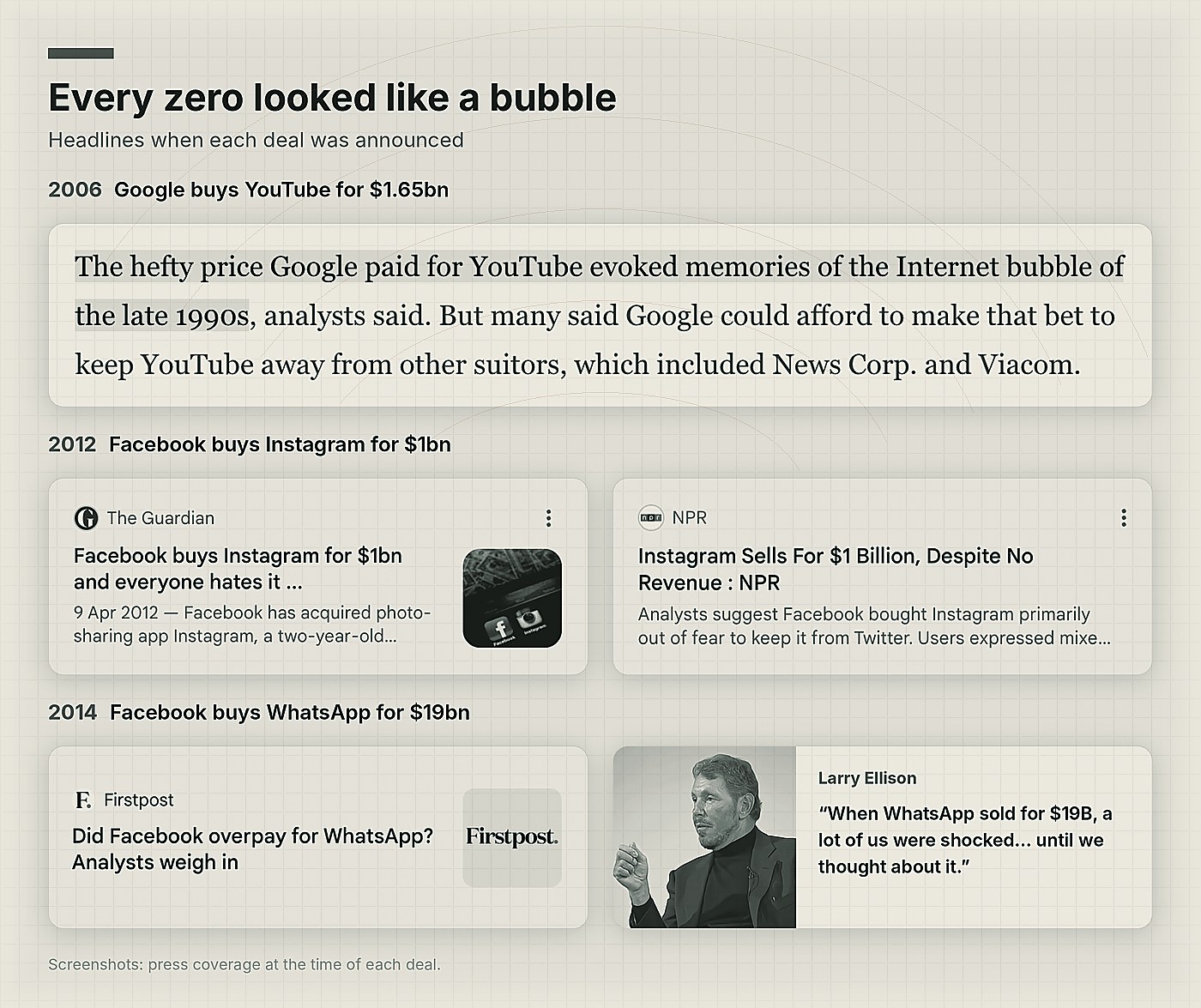
A few years ago I was having breakfast with @Jeremy Liew of Lightspeed. He mentioned something that has become a core framework on how I think about these technology waves. To paraphrase Jeremy, each of these waves adds a zero to the outcome sizes. A zero at the end of TAM you can serve. A zero at the end of M&As. A zero at the end of IPOs. These things can be called sound bytes but I recall when Google acquired Youtube for $1B, it was widely criticized for overpaying. Same when Facebook acquired Instagram for $1B. John Steward of the Daily Show famously said “A billion dollars of money?! For a thing that kind of ruins your pictures?"
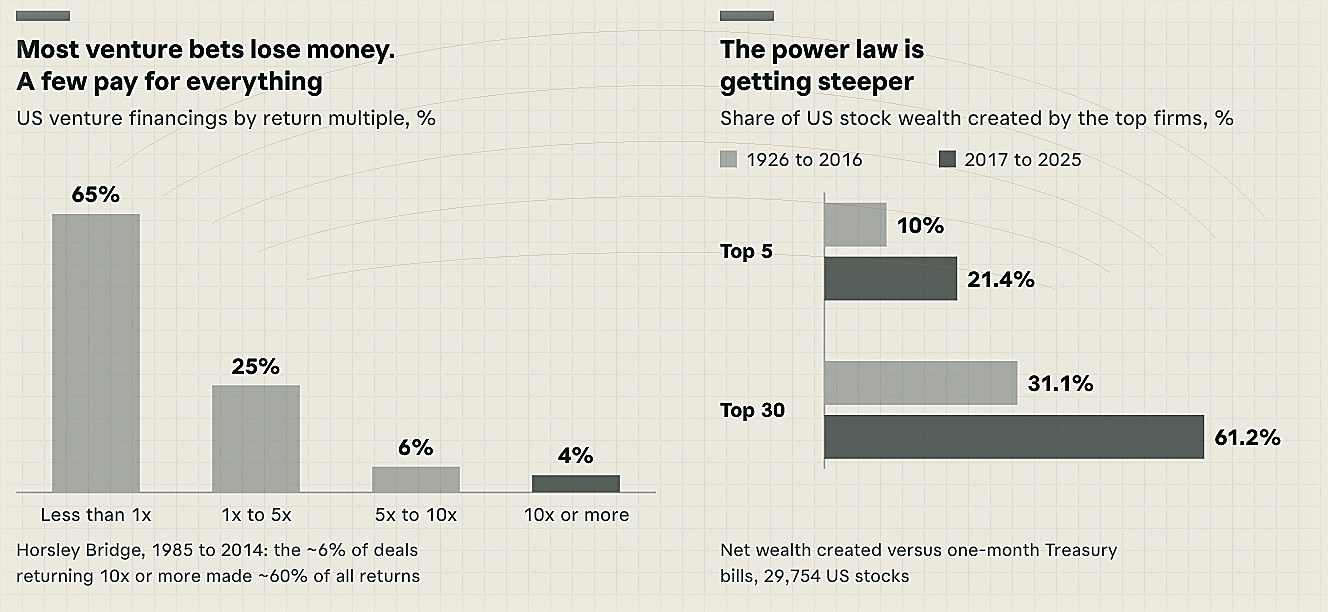
Google listed at about $23B, Facebook at $104B. SpaceX listed in June at about $1.7T. The valleys are deeper too. This AI cycle, the share of US seed companies raising a Series A within two years fell from 30.6% for the 2018 cohort to 15.4% for 2022, and Carta shutdowns rose from 769 to 966 in a year. Meanwhile seven companies took just over half of all US venture dollars in 2026, and North American deal counts hit a three-year low while dollars rose 50%. That's what jagged means. A few spikes, a long flat plain, and a lot of holes.
What's new is that the curve is bending harder. The five biggest US wealth creators took about 10% of all the wealth created from 1926 to 2016. From 2017 to 2025 they took 21.4%. The top 30 went from 31% to 61%. Nvidia alone created more shareholder wealth in those nine years than ExxonMobil did in the ninety before them. The winners aren't just winning anymore. With every cycle they take a bigger share of the whole pie.
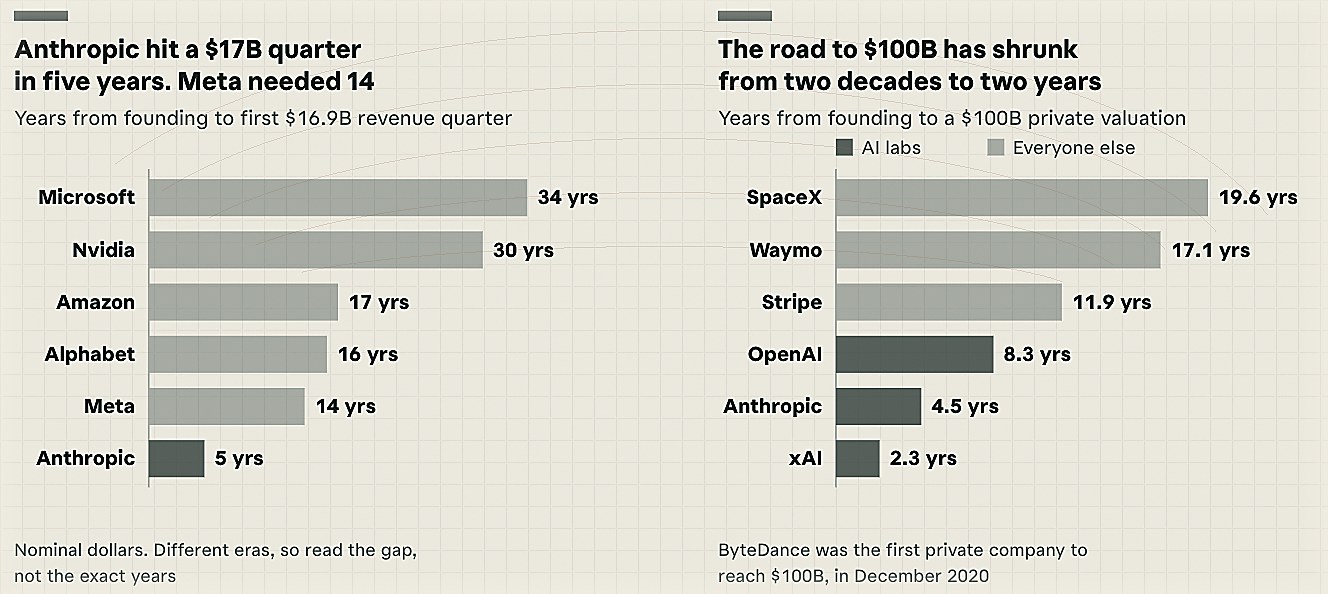
The peaks arrive not just higher, but faster too. A $100B private valuation didn't exist until ByteDance got there in December 2020. SpaceX needed almost 20 years. Stripe needed 12. OpenAI did it in about eight, Anthropic in four and a half, and xAI in a little over two.
You could argue that's just cheap money chasing a story. Anthropic booked $16.96B of revenue in Q3 2026, up from $1.4B a year earlier, about five years after it was founded. Meta needed 14 years to post a quarter that big. Google needed 16, Amazon 17 and Microsoft 34.
A few forces make each wave steeper than the last. AI sells the work, not the tool, so the ceiling moved from IT budgets to the $20T labor and opex budget we've written about a few years ago. The floor of 'what's possible' also moves every quarter, as each model release floods some category. Capital has become the moat in this extractive, capex-heavy phase of the supercycle, with a record 27 billion-dollar rounds in Q3 alone. Products go global in a weekend, and so do their replacements. And the frontier has moved into atoms, where aerospace, robotics, chips and energy each raised more than $10B last quarter and every bet is binary. SpaceX nearly died in 2008. This June it listed at $1.7T. True venture art.
2. The founder is jagged
Alexandr Wang started Scale at 19. Mercor's founders started at 19 and were the youngest self-made billionaires ever at 22. Forbes' 2026 list had 35 billionaires under 30, 12 of them self-made. Unlike their predecessors, the new crop of billionaires increasingly do not graduate into a role over years, they drop out into one, usually out of a lab, a club or an IMO/InPho/Topcoder competition team.
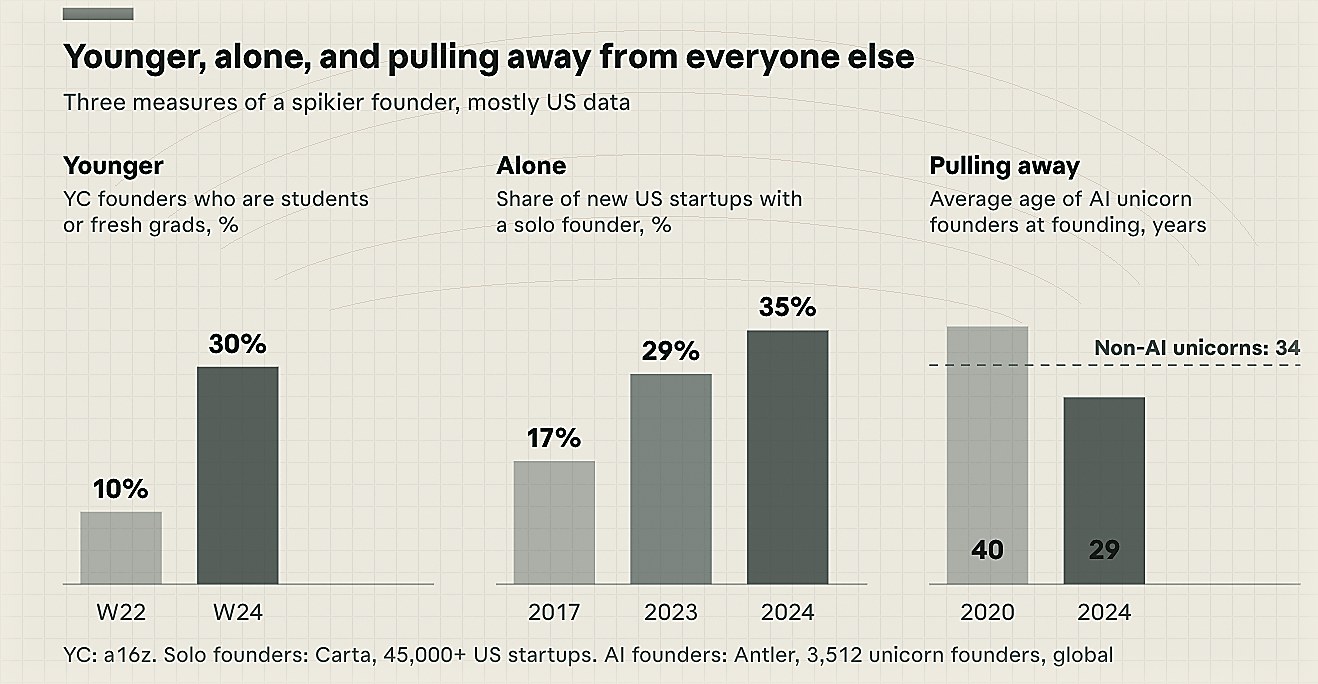
The data backs it. Rebel Fund found the average YC founder fell from about 29 to about 26 after 2023, and under-25s now outnumber everyone else. In YC's W24 batch, 30% were students or fresh grads, up from 10% two years earlier. Solo founders went from 17% of new US startups in 2017 to 35% in 2024. And Antler's study of 3,512 unicorn founders shows AI founders went from 40 to 29 at founding between 2020 and 2024, while non-AI founders got older.
It's still a sprinkle. Only 2.3% of founders are under 25. But in a power law we don't need thousands of them. We need the ten who are real.
At the other end are founders who spent a decade inside a problem before anyone called it a market. Ilya Sutskever raised $1bn for SSI before shipping anything. Mira Murati raised a $2bn seed at 36. Yann LeCun left Meta at 65 and raised a seed of just over $1bn. Researcher-led neolabs have raised more than $40bn since 2024. Sarvam is the Indian version: Vivek Raghavan spent about 12 years building Aadhaar, and Pratyush Kumar was IIT Madras faculty.
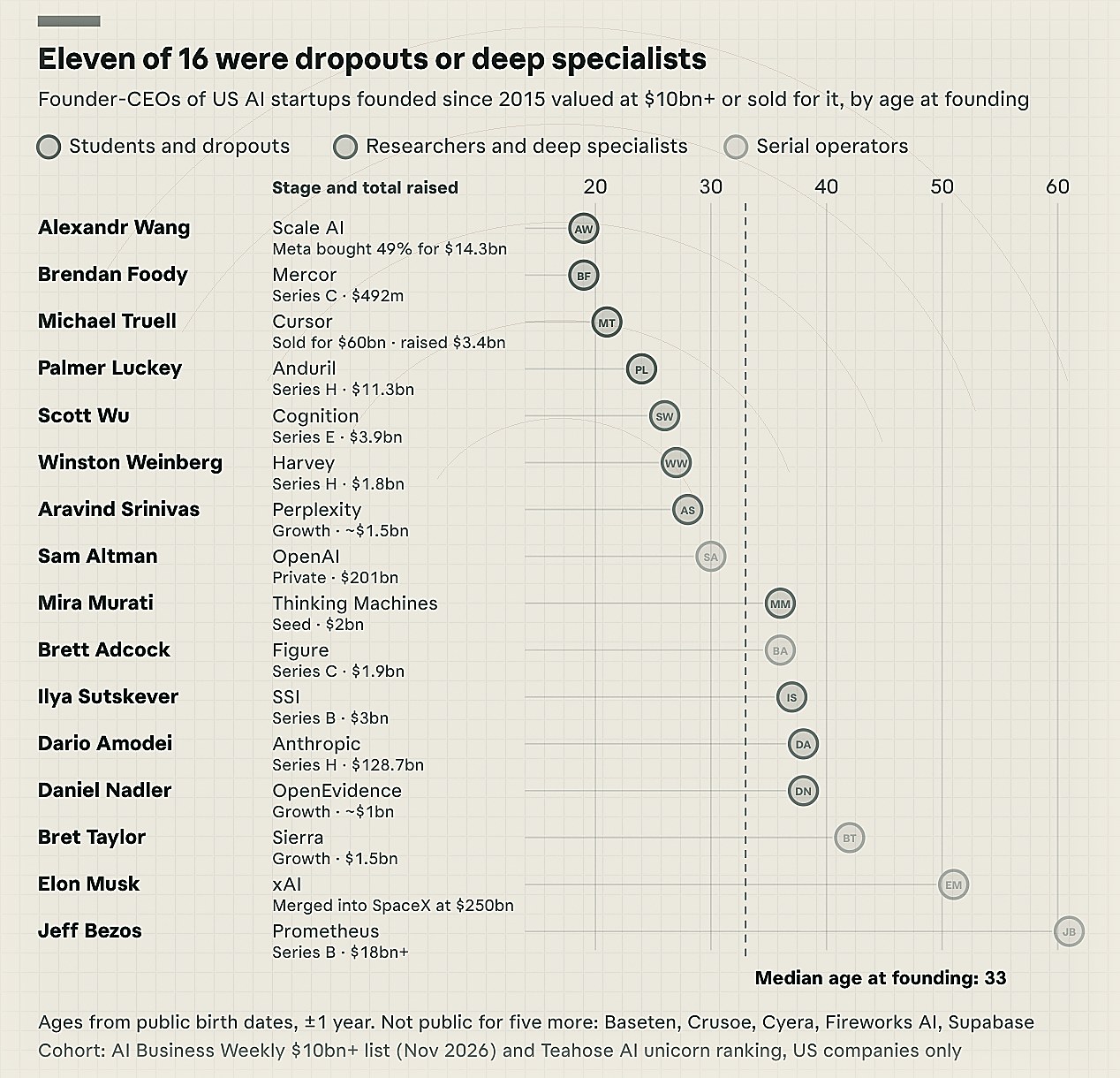
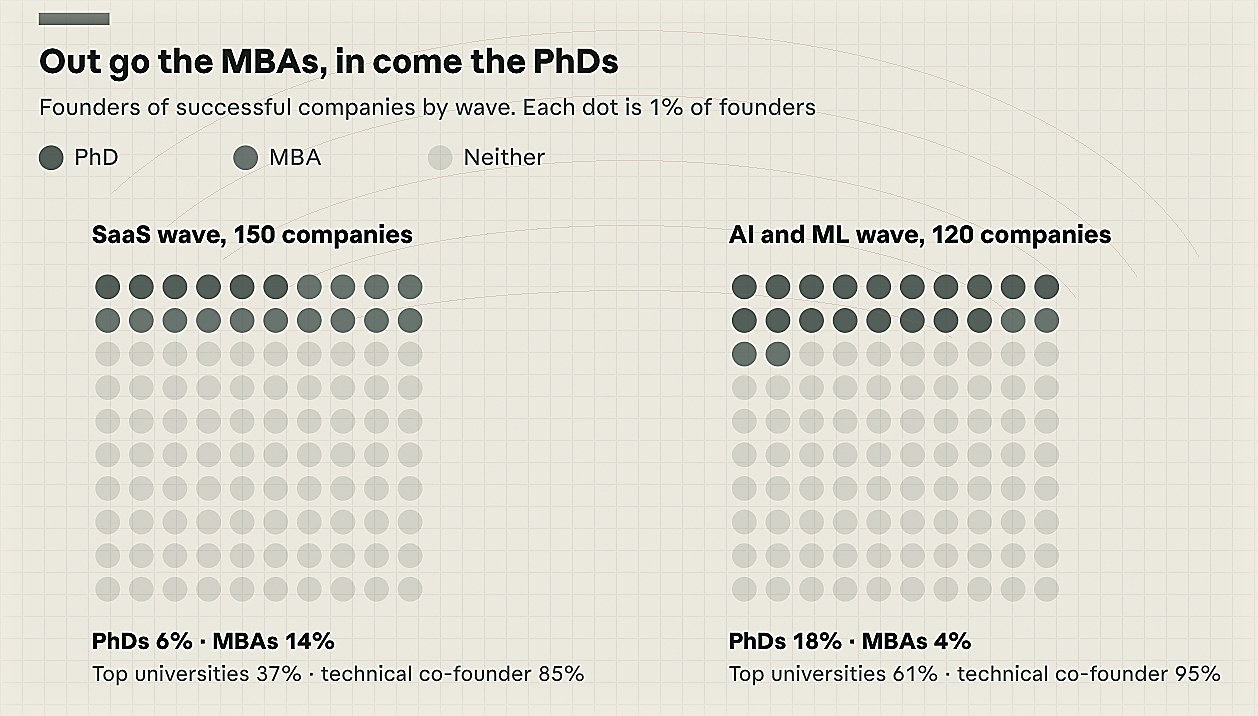
So the founder distribution isn't just getting younger. It's going barbell. Another spike is technical. Across 645 founders of 150 SaaS winners and 120 AI companies on the same path, PhDs went from 6% of founders to 18%, MBAs fell from 14% to 4%, and founders from top universities rose from 37% to 61%.
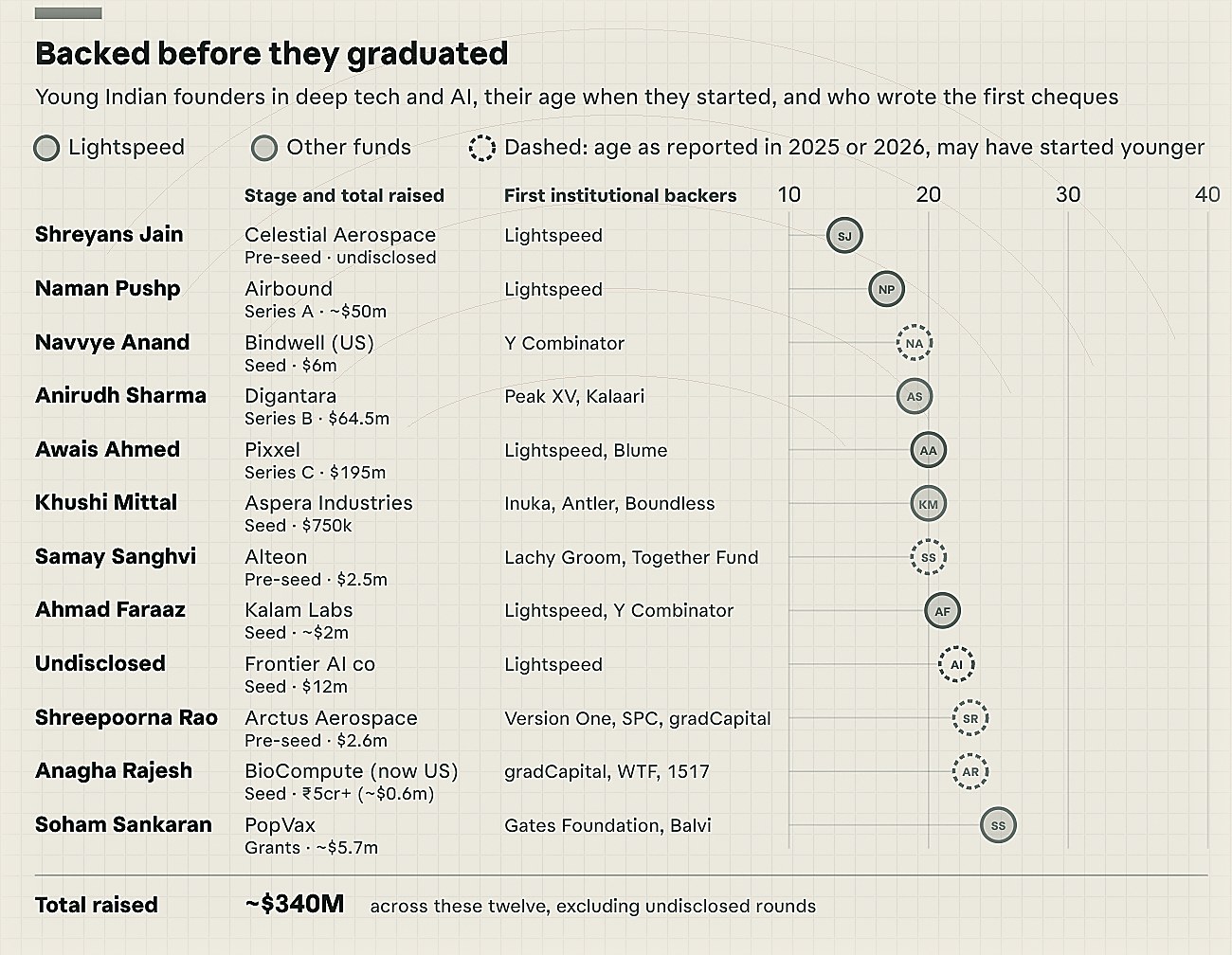
India is showing a similar trend towards younger. We backed Naman Pushp of Airbound at 17, Shreyans Jain of Celestial Aerospace at 14, Ahmad Faraaz, who started Kalam Labs at 21, and recently an under-stealth team of some of the smartest AI researchers we've met this year straight out of IIIT Hyderabad. Our peers have also followed suit. Anirudh Sharma of Digantara started at 19 out of a student satellite club. Arctus Aerospace has a 23-year-old founder. Lachy Groom and Together Fund just backed 20-year-old Samay Sanghvi's Alteon, which wants to keep drones in the air for a year, and Khushi Mittal dropped out of Alberta at 20 to build autonomous seaplanes at Aspera. And Soham Sankaran, a computer scientist with almost no biology background, started PopVax in 2021 and this August dosed the first humans with its mRNA vaccine. Between them, the twelve below have raised about $340M.
Rebel's data also shows founders under 26 end up with more dead companies, founders over 30 with more zombies. Jagged founders produce jagged outcomes. The founder having the hardest time now is the well-rounded one in the middle.
3. The financier has to be jagged too
If the frontier and the founders are jagged, a flat investor is just going to get flat returns. Gompers, Kovner and Lerner found in 2009 that the more specialized an individual VC, the more often their companies succeeded. Generalists allocated badly across industries and picked badly within them. A generalist firm staffed with specialists did fine. The label on the fund doesn't matter. The depth of the person does.
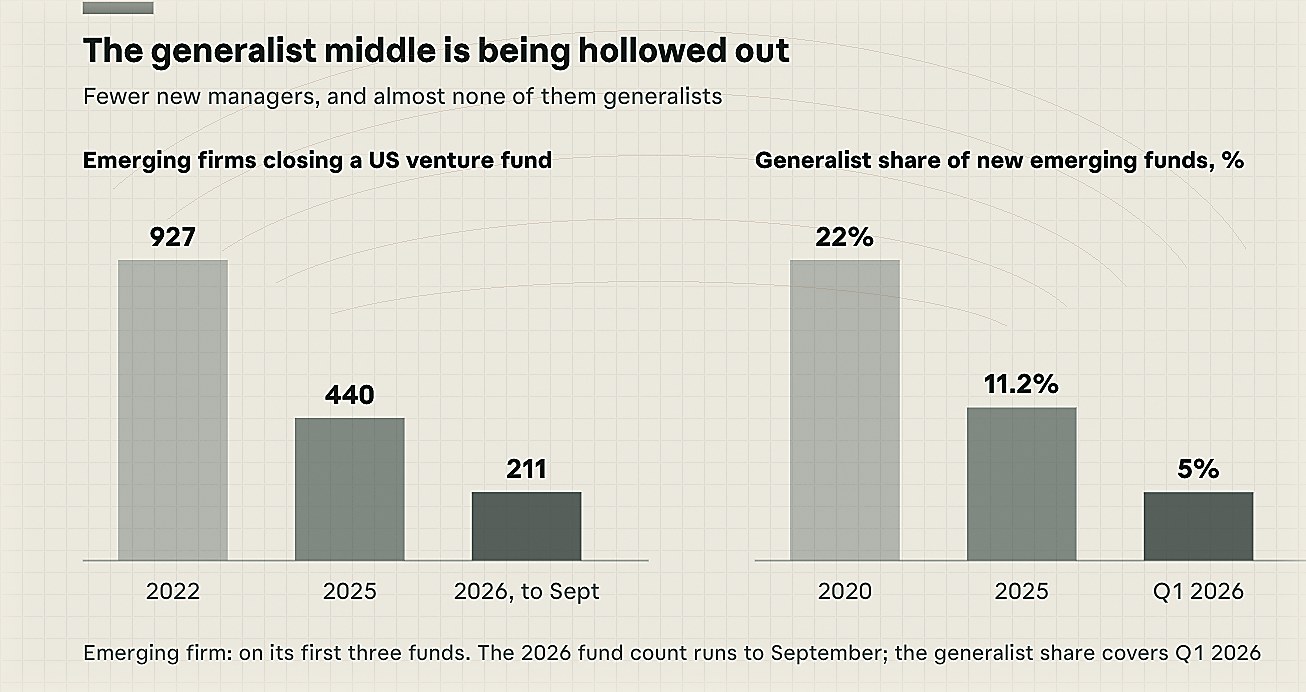
The market is starting to shift. Generalist strategies fell from 22% of new emerging funds in 2020 to 5% in Q1 2026. Emerging firms closing a US fund fell from 927 in 2022 to 211 this year. You either have a balance sheet the size of a country or an edge the width of a needle.
Depth matters more now because AI makes smart people more confident and more wrong. If your decks are built by AI and evaluated by AI without you having any instinct or knowledge on much, then you are one step away from getting prompt-injected and invest in another Theranos before long.
This isn't just about technical frontier. In commerce, you need a view on how agents change discovery and checkout, what PMF feels like when the buyer is an agent, and what margin looks like after inference. In applications, know where the models will be in 18 months and where the flood line sits for every company you see. Read evals, not demos.
In deep tech, one needs to go several levels deeper. The person who's great at nuclear can't underwrite drones, and the drone person can't underwrite rocket launches. You need to be able to read a technical document and be able to at least have a view this is very interesting or just another technical cul-de-sac.
If you are a frontier AI investor, can you reproduce the founder's demo? Do you know the 5-10 people who could build this instead? Are you reading 2-3 papers a week, or even a month? Do you stay abreast of what different neolab approaches to the next frontier are? When was the last time you were on arXiv? Would the founder learn something from you? More than three nos and you're just a tourist.
Stand for something
Generalist VC isn't a strategy anymore. The best founders have gone so deep into the technological rabbit-holes that investors have to follow if they have any chance of dreaming along-side them. The peaks have never been taller, the valleys never wider, the founders never spikier. Being pretty good at everything is now the riskiest position on the board.
The frontier is jagged. The founders are jagged. The money had better learn to hill climb.
No comments yet.